
How We Grew a Pakistani Exam-Prep Website’s Organic Clicks 257x in 13 Months
Education content website · Pakistan · August 2025 – October 2026
ملخص بالعربية: دراسة حالة حقيقية لموقع تعليمي باكستاني — نمو الزيارات العضوية من جوجل من ١٤ زيارة يوميًا إلى ٣٬٥٢٥ زيارة يوميًا خلال ١٣ شهرًا (٢٥٧ ضعفًا).
Snapshot
- Industry
- Education — CSS exam preparation & informational content website
- Location
- Pakistan (97.5% of organic traffic)
- Timeframe
- August 2025 – October 2026 (13 months)
- Services
- Technical SEO, on-page SEO, content strategy & topical authority
All figures: Google Search Console, August 2025 vs September–October 2026.
The Challenge
When this client came to us, their website was practically invisible on Google. The site served Pakistani students preparing for the CSS examination — one of the country’s most competitive exams — but it was earning barely a dozen organic clicks a day, buried around position 27 on average. For a content website, that is the same as not existing.
The challenge was threefold. First, the site was new, with almost no topical authority — Google had little reason to trust it over established education portals and news sites that had dominated these queries for years. Second, the most valuable queries in this space are brutally competitive: terms like “8171” (the BISP welfare portal) and “css syllabus” are contested by government domains, major news outlets, and entrenched publishers. Third, the site’s content footprint was thin — a handful of pages competing for a topic universe that spans exam syllabi, past papers, welfare schemes, salary charts, and national events.
What made this engagement interesting is that the client understood content is a volume game in informational SEO, but they had no system for deciding what to publish, how to structure it, or how to earn Google’s trust fast enough to matter. They needed an SEO strategy built for a publisher: technical foundations that let Google crawl thousands of pages efficiently, and a content strategy that built topical authority in layers — starting with the exam-prep core, then expanding into the high-demand civic and trending queries Pakistani audiences search for every day.
The Strategy
Phase 1: Technical foundations & the exam-prep core (Months 1–3)
We started where every publisher must: making the site effortlessly crawlable. Clean site architecture with logical topic silos, fast load times, proper schema markup, and an internal linking structure that pushed authority toward the pages that mattered most. In parallel, we built out the exam-prep core — comprehensive syllabus pages and solved past-paper content for the CSS and MPT exams. These pages targeted queries with clear intent and weaker competition, giving Google early reasons to trust the domain. The “css syllabus” cluster became the site’s first real foothold, eventually reaching position 4.27 with nearly 15,000 clicks.
Phase 2: Topical expansion into civic queries (Months 4–7)
With the exam core ranking, we expanded into adjacent high-demand Pakistani queries — BISP/8171 payment guides, salary increase charts, and income tax slabs. These topics share the same audience (Pakistani citizens navigating government schemes and employment news) and let us build topical authority far beyond exam prep. Each guide was built to be the most complete resource on its query: step-by-step CNIC check instructions, BPS-wise pay charts, month-specific payment updates. The salary-increase-chart page alone would go on to earn over 161,000 clicks at position 4.42.
Phase 3: Event-driven content velocity (Months 8–11)
This is where growth went exponential. We built a system for publishing around predictable national events — the federal budget, the FIFA World Cup 2026 schedule in Pakistan time, Ramzan welfare packages — with content live before demand peaked. The FIFA World Cup schedule page captured over 68,000 clicks at position 5.41; the June 2026 peak (354,347 clicks in a single month, including a 34,049-click day) coincided with budget-season salary queries colliding with World Cup search demand. Speed mattered as much as quality: being first with a complete, accurate resource beats being tenth with a better one.
Phase 4: Compounding & sustaining (Months 12–13)
By month twelve the site had become a recognized entity in its topic space: 999 of 1,000 tracked queries ranking in Google’s top 10, 341 in the top 3. The work of our SEO services shifted to protecting and compounding — refreshing month-specific guides (BISP payment pages are published per month), defending positions against news-site competitors, and pruning or consolidating underperformers. Growth stabilized at a far higher baseline: the final two weeks averaged 3,525 clicks per day, roughly 257 times the starting point.
The Results
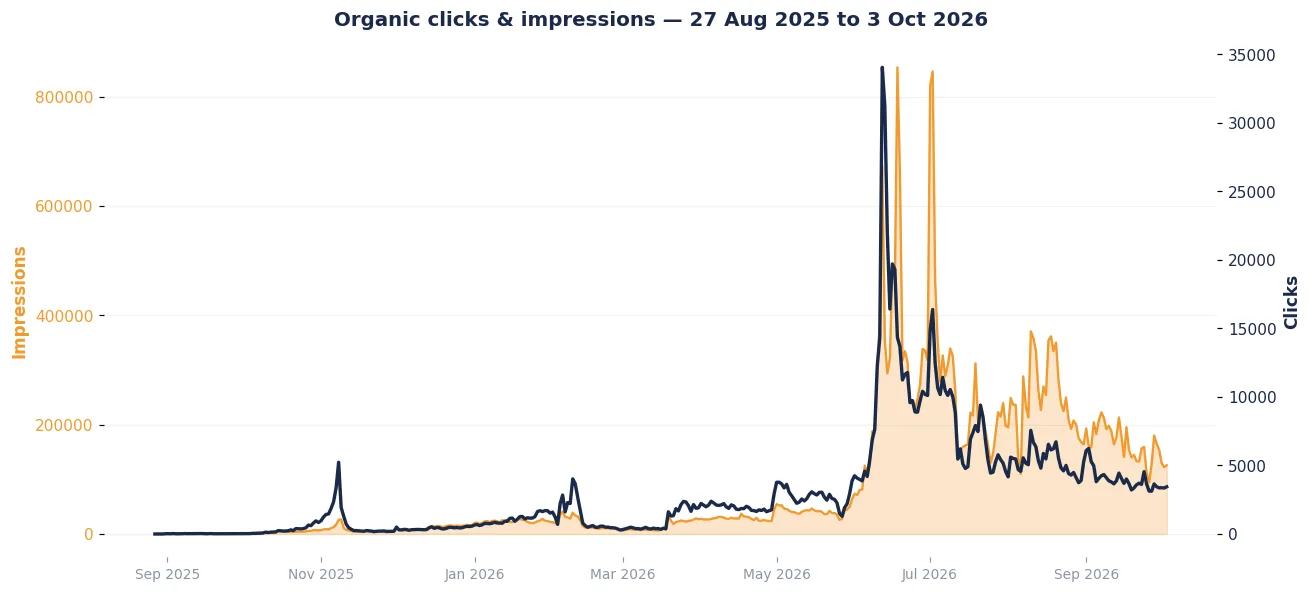
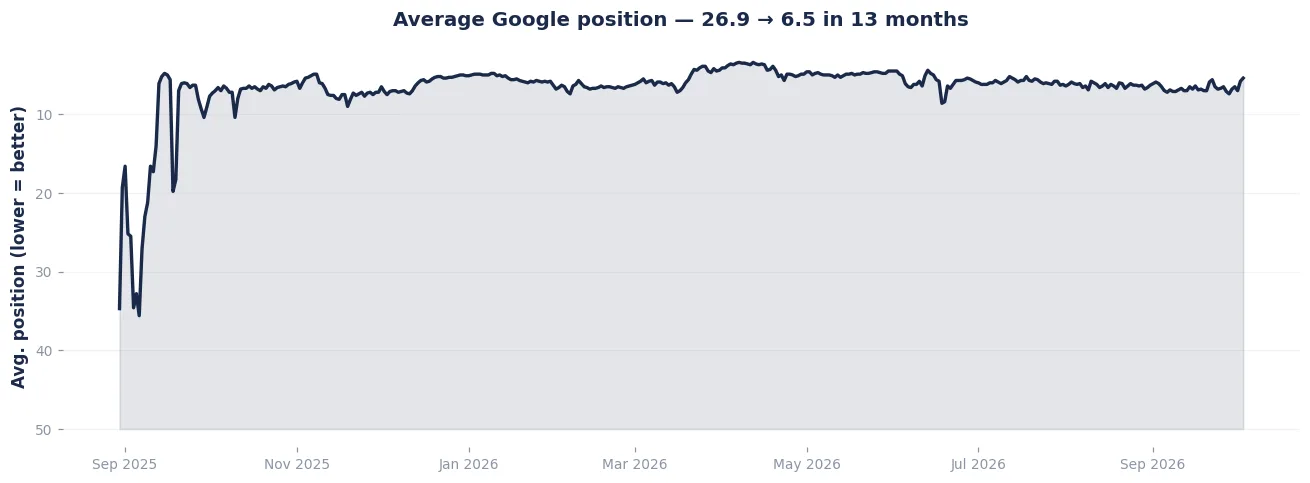
Thirteen months. From 13.7 organic clicks a day to 3,524.9 — a 257-fold increase. From 608 daily impressions to 138,423. From an average position of 26.9 (page three, where nobody looks) to 6.5 (top of page one, where everyone clicks). In total: 1,189,175 clicks and 35.3 million impressions, with 97.5% of traffic coming from Pakistan and 77% from mobile — exactly the audience this publisher serves.
The keyword footprint tells the deeper story: 999 of 1,000 tracked queries now rank in Google’s top 10, and 341 sit in the top 3 — including “css syllabus 2026” at position 2.67 and “fifa world cup 2026 schedule pakistan time” at 3.02. Beyond Search Console, Google Analytics confirms real human engagement: 699,383 active users and 8.74 million events over the period, with visitors spending an average of 144 seconds per session — strong engagement for informational content.
Every figure below is real Google Search Console data — 27 August 2025 to 3 October 2026.
Thirteen months apart. Orange is after.
Authority built in layers — then compounding.
Exam-prep core
built first
Civic content
expansion working
34,049-click day
Budget + World Cup
Avg. position 6.5
999 queries top 10
Scale with the right audience behind it.
of clicks came from Pakistan — the exact audience the site serves
of clicks came from mobile — readers on their phones
of tracked queries rank in Google’s top 3 — 341 keywords
Questions People Ask About This Kind of Growth
How long does it really take a new website to get meaningful SEO traffic?
This is the most-asked question on SEO forums, and the honest answer is 6–12 months for most sites. In this case: 13 months from near-zero to 3,525 clicks a day. The first real inflection came at month 3–4 as the exam-prep core started ranking, acceleration hit at months 6–8 with the civic-content expansion, and the exponential peak arrived at months 10–11 when event-driven content compounded on established authority. Anyone promising faster for a brand-new domain is selling something.
Can a new site really outrank government websites and big news portals?
Yes — and this case study is the proof. The query “8171” is contested by government domains, yet this site earned 23,276 clicks on it. Topical authority is topic-specific, not site-wide: a focused site covering one subject completely can outrank far bigger domains on that subject. Google rewards the most complete, most helpful resource — not the biggest brand.
How much content does it take to build topical authority?
There is no magic number, but expect dozens of interlinked articles per topic cluster — not a handful of posts. Here the sequencing mattered more than raw volume: exam-prep core first (syllabus, past papers), then civic queries (BISP guides, salary charts), then event content (budget, World Cup). Each layer made the next one rank faster. The World Cup schedule page would never have ranked in month one; in month ten it captured over 68,000 clicks.
Does chasing trending topics actually build lasting SEO value?
Only if there is authority underneath. Trending content on a brand-new site rarely ranks and decays fast. On an established topical base it compounds — June 2026’s 354,347-click month came from event content riding on ten months of built authority. Treat trends as accelerant, not foundation.
What would an engagement like this cost?
It depends on content volume and competition, but work of this shape typically sits within our Growth to Premium plan range — see our SEO pricing for current figures. The most accurate quote comes from a free audit of your own site. Past results don’t guarantee future rankings — here’s how we talk about expectations.
More Case Studies
8x Organic Clicks in 112 Days — Online Tools Website
Online tools website — South Asia
Read the case study →635x Organic Clicks in 4 Months — Pakistani CSS Syllabus Website
Niche exam-resources website — Pakistan
Read the case study →
How We Grew a Dubai Mobile Car Service’s Organic Clicks 8x in 90 Days
Mobile car services — Dubai, UAE
Read the case study →Zero to Page 1 in 90 Days — Karachi Construction Company
Construction company — Karachi
Read the case study →Want results like these for your business?
Every engagement starts with a free audit — see exactly what’s holding your site back before you spend anything.
Past results don’t guarantee future rankings — here’s how we talk about expectations.