
How We Grew a Pakistani CSS Syllabus Website’s Organic Clicks 635x in 4 Months
Niche exam-resources website · Pakistan · June – October 2026
ملخص بالعربية: دراسة حالة سيو لموقع متخصص في مناهج اختبار CSS — نمو الزيارات العضوية من أقل من زيارة يوميًا إلى ٢٧٢ زيارة يوميًا خلال ٤ أشهر (٦٣٥ ضعفًا).
Snapshot
Metric callouts: Google Search Console, first vs last 14 days.
The Challenge
Some sites try to be everything. This one had the opposite problem — and the opposite opportunity. A tightly focused website covering the CSS examination syllabus and MPT past papers for Pakistani aspirants, it was earning less than one organic click per day in June 2026, sitting at position 16.7 on average. Practically invisible.
The niche is small but the intent is gold. Someone searching ‘css syllabus 2026’ or ‘mpt past papers’ is a committed exam candidate — they download, they return, they share. But the queries are contested by established education portals, and a thin new site with a handful of pages had no topical weight to throw around. The challenge wasn’t breadth — it was depth: convincing Google that this small site was the single most complete resource for the CSS syllabus topic cluster, page after page.
Unlike broad publishers that dilute authority across hundreds of unrelated topics, this site’s narrowness was its weapon — if we clustered it correctly. The strategy was focus: own the syllabus, own the MPT papers, own every sub-query around them, and let topical density do what backlinks do for bigger sites.
The Strategy
Phase 1: Technical cleanup & crawl efficiency (Month 1)
A 150-page niche site lives or dies on crawl efficiency — and on precise on-page SEO. We tightened site architecture so the syllabus hub, MPT section, and past-paper archives sat within minimal click-depth of the homepage, fixed technical issues slowing Google’s discovery of new pages, and implemented schema markup for the exam-resource content. The homepage — which would become the site’s top traffic driver at 3,906 clicks — was optimized as the topical pillar everything else pointed to.
Phase 2: The MPT past-papers cluster (Months 1–2)
Data showed MPT (screening test) queries converting impressions to clicks fastest, so we built the cluster out aggressively: a central past-papers hub with year-wise archives (2025, 2026), each optimized for its specific query variant. The hub alone captured 3,409 clicks at position 5.14 — proof that one deeply-built cluster beats ten shallow pages. ‘mpt past papers’ reached position 4.32; ‘css mpt past paper’ hit 4.41.
Phase 3: Syllabus query ownership (Months 2–3)
With the MPT cluster ranking, we expanded across the syllabus query set: ‘css syllabus 2026’ (721 clicks, position 4.52), ‘css syllabus 2027’ (342 clicks, 5.69), ‘fpsc css syllabus 2026 pdf download’ (306 clicks, 3.73), plus subject syllabi like criminology. Each page targeted one query variant precisely — no cannibalization, no generic catch-alls. By September the site was pulling 5,613 clicks in a single month, up from 47 in June.
Phase 4: Compounding the niche (Month 4)
By month four, 945 of 1,000 tracked queries sat in Google’s top 10. The work shifted to defending and extending: refreshing paper archives as new exams approached, tightening internal links from new pages to the hub, and capturing emerging variants (‘css syllabus 2027’ was already climbing at position 5.69). The lesson of this engagement: in a focused niche, depth compounds faster than breadth — the same principle behind our SEO services.
The Results
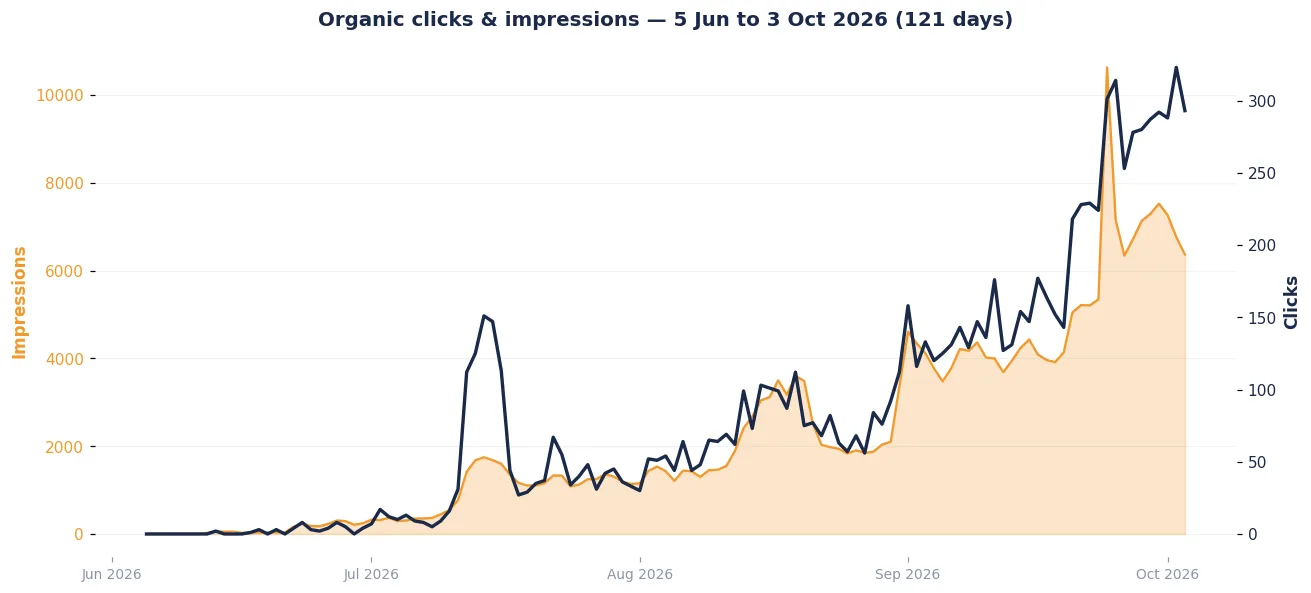
One hundred twenty-one days. From 0.4 organic clicks a day to 272 — a 635-fold increase. From 20 daily impressions to 6,716. From position 16.7 (page two, invisible) to 5.4 (top half of page one). Total: 10,183 clicks and 270,372 impressions, 99.3% of them from Pakistan, 69% from mobile — exam aspirants on their phones.
The concentration tells the niche story: the homepage (3,906 clicks) and the MPT past-papers hub (3,409) together drive over 70% of traffic — two pillars holding up the entire topic. And the keyword footprint is remarkably efficient: 945 of 1,000 tracked queries in the top 10 from a 150-page site. Google Analytics confirms real users behind the clicks: 10,860 active users over the period, nearly all new visitors discovering the site for the first time.
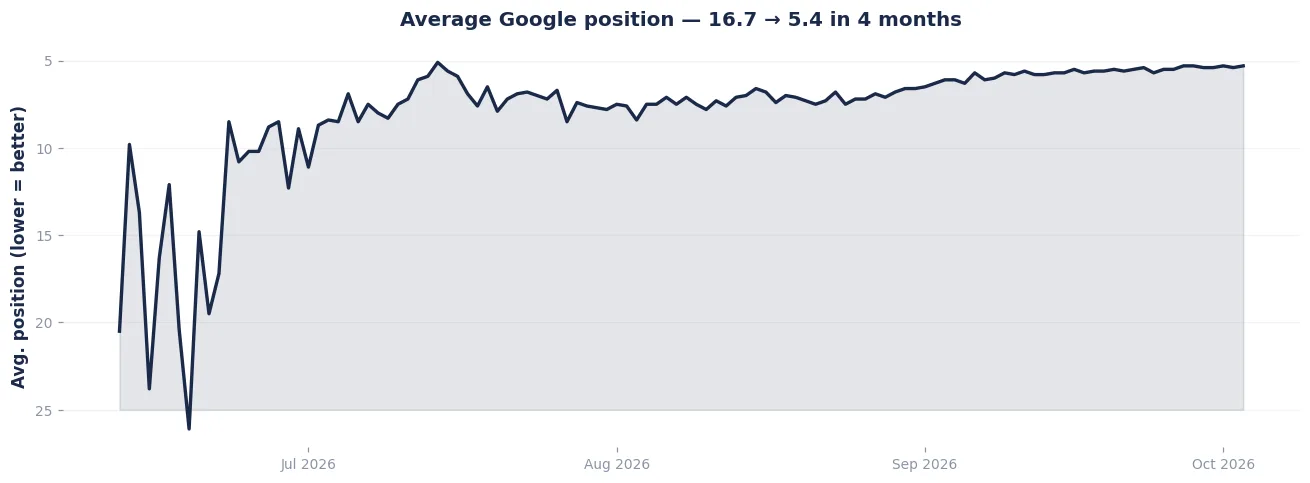
Every figure below is real Google Search Console data — 5 June to 3 October 2026.
First two weeks vs last two weeks. Orange is after.
Depth compounding — every month bigger than the last.
Less than 1 click/day
Position 16.7
MPT cluster
takes off
join in
Position 7.2
119x June
Position 5.7
Committed exam candidates — the highest-intent audience in education.
of clicks came from Pakistan — CSS aspirants
of clicks came from mobile — studying on phones
of clicks from 2 pillar pages — homepage + MPT hub
Questions People Ask About Niche SEO
Is a 635x multiple misleading when you start from almost zero?
It’s honest as long as the baseline is stated — and we state it: 0.4 clicks a day. Multiples from near-zero always look dramatic; what matters is where you land. Landing at 272 clicks a day, position 5.4, with 945 top-10 queries in four months is a genuine result regardless of the starting point. We show the absolute numbers alongside every multiple for exactly this reason.
Why did such a small site rank so fast?
Focus. Google doesn’t rank ‘websites’ — it ranks topical depth. A 150-page site covering one exam comprehensively can outrank a 10,000-page portal on that exam, because every internal link, every page, and every query reinforces the same topic. Broad sites dilute; niche sites concentrate. Four months of concentrated topical building beat years of diluted publishing in this query set.
Homepage + one hub driving 70% of traffic — isn’t that risky?
It’s the nature of niche sites: a strong pillar structure concentrates authority where it converts best. The risk would be real if those pages were thin — they’re not; they’re the deepest resources on their queries. And the long tail is healthy underneath: 150 pages earning traffic, 945 top-10 queries. Concentration at the top with breadth below is the ideal shape.
How is this different from a broad education publisher strategy?
Breadth vs depth. A broad publisher (like our longer-running exam-prep case study) wins by covering hundreds of topics and compounding over a longer timeline. This site won in four months by refusing breadth entirely — syllabus, MPT papers, and nothing else. Different games, different timelines; the right choice depends on the site’s resources and the market’s structure.
What would an engagement like this cost?
Niche-site engagements of this shape typically sit within our Growth plan range — see our SEO pricing for current figures. A free audit of your niche’s competitiveness gives the exact quote. Past results don’t guarantee future rankings — here’s how we talk about expectations.
More Case Studies
All Case Studies
Every SEO case study and client result, in one place.
Browse all case studies →8x Organic Clicks in 112 Days — Online Tools Website
Online tools website — South Asia.
Read the case study →Zero to Page 1 in 90 Days — Karachi Construction Company
Construction company — Karachi.
Read the case study →257x Organic Clicks — Pakistani Exam-Prep Website
Education website — Pakistan.
Read the case study →+736% Organic Clicks in 90 Days — Dubai Mobile Car Service
Mobile car service — Dubai, UAE.
Read the case study →5.3x Organic Clicks in 96 Days — Lahore CSS Academy
CSS exam academy — Lahore
Read the case study →Want results like these for your business?
Every engagement starts with a free audit — see exactly what’s holding your site back before you spend a rupee.
Past results don’t guarantee future rankings — here’s how we talk about expectations.