
How We Scaled an Online Tools Website 8x in 112 Days — Without Losing Page-One Rankings
Free web-utilities website · South Asia · May – August 2026
ملخص بالعربية: دراسة حالة سيو لموقع أدوات مجانية على الإنترنت — نمو الزيارات العضوية ٨ أضعاف خلال ١١٢ يومًا مع الحفاظ على مراكز الصفحة الأولى.
Snapshot
Metric callouts: Google Search Console, first vs last 14 days.
The Challenge
This engagement started from an unusual place: the site was already winning. At position 6.5 on average — solidly page one — a free web-utilities website serving South Asia was earning a respectable 144 organic clicks a day. The owner didn’t need rescue; they needed scale. The question was whether 8x growth was possible without the rankings collapsing under the weight of expansion.
That’s a real risk. Fast-growing tool sites usually face one of two traps: they add pages that cannibalize their winners, or they chase new queries and dilute the topical focus that earned their rankings. Either way, average position slides — and with it, the traffic they already had. The challenge here was growth with discipline: multiply the traffic while keeping the site’s page-one foundation exactly where it was.
The raw materials were strong. A flagship tool page was already pulling the majority of traffic. The audience was overwhelmingly mobile — 98% of clicks — and concentrated in Pakistan, India, and Bangladesh, where the site’s utilities had deep product-market fit. Everything pointed to scale; the strategy had to protect what already worked.
The Strategy
Phase 1: Protect the flagship (Weeks 1–2)
Before touching anything, we ring-fenced the winner. The flagship tool page drove 75% of all traffic (94,589 clicks at position 6.18), so its first job was defense: technical health checks, Core Web Vitals on mobile, and confirming no planned change could disturb its rankings. Growth means nothing if you break the engine first. Every subsequent change was measured against this page’s stability — the same discipline behind our on-page SEO work.
Phase 2: Query expansion around proven winners (Weeks 3–6)
Instead of inventing new topics, we mined the site’s own Search Console data for queries it was already visible for but under-serving — impressions without clicks, page-two rankings adjacent to the flagship’s topic. New and optimized pages targeted these variants precisely, each mapped to one query to avoid cannibalization. The head term alone carried 468,381 impressions; capturing more of that existing demand was the fastest lever. Supporting tool queries climbed to positions 1.2–2.8.
Phase 3: Mobile-first execution (Weeks 6–10)
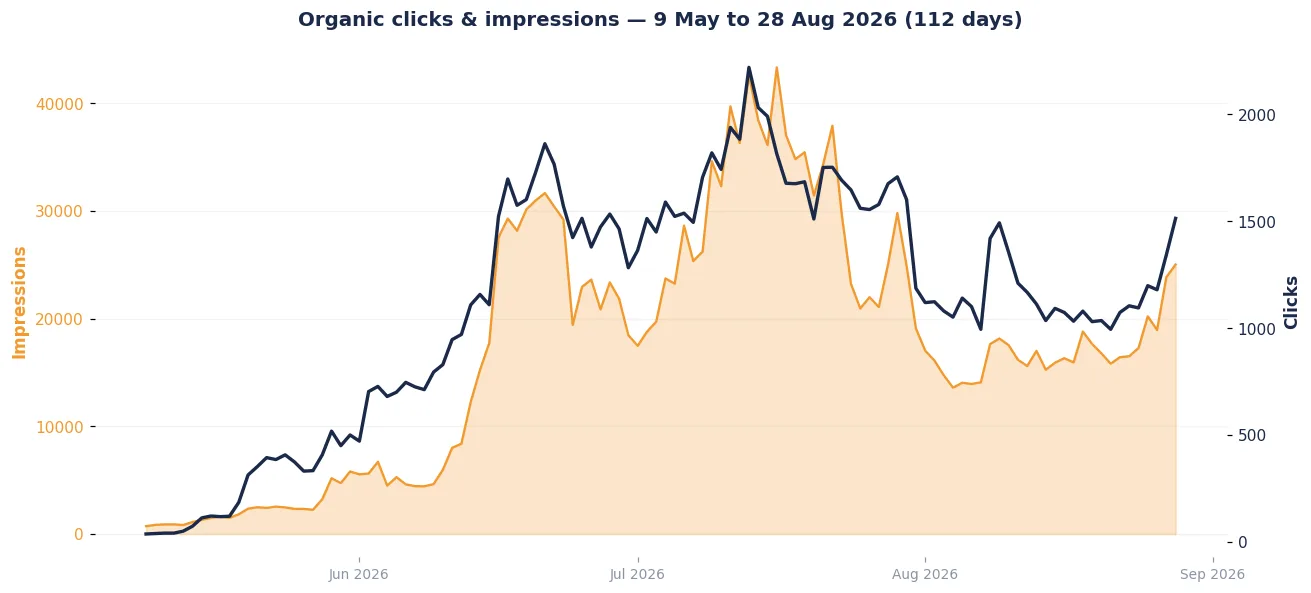
With 98% of clicks coming from mobile, every optimization was judged on a phone screen. Tool pages were streamlined for thumb-speed use, page speed tightened, and the interaction flow kept frictionless — because for utility sites, a slow tool is a bounced visitor, and bounced visitors don’t come back through Google. June’s 35,794 clicks became July’s 51,885 as the expanded query footprint compounded.
Phase 4: Scaling without slipping (Weeks 10–16)
The final phase was vigilance. As new pages ranked, we watched average position like a hawk — the whole engagement’s thesis was growth without slippage. Internal linking was tuned so new pages reinforced rather than competed with the flagship. Result: 8x the clicks, 12.6x the impressions, and average position moved from 6.5 to 6.7 — page one, held. That’s the standard we hold across our SEO services.
The Results
One hundred twelve days. From 144 organic clicks a day to 1,132 — a 7.9-fold increase. From 1,451 daily impressions to 18,251. Total: 125,665 clicks and 1,942,722 impressions. And the number that matters most: average position 6.5 → 6.7. The site grew 8x and never left page one.
The structure of the win is instructive. The flagship tool page held its 75% share while the long tail exploded underneath it — 992 of 1,000 tracked queries now sit in Google’s top 10, up from a fraction of that, built on just 49 pages. The audience profile stayed constant: 98% mobile, three-quarters Pakistani, the rest Indian and Bangladeshi — the same users, multiplied. Peak day: 2,220 clicks on 13 July 2026.
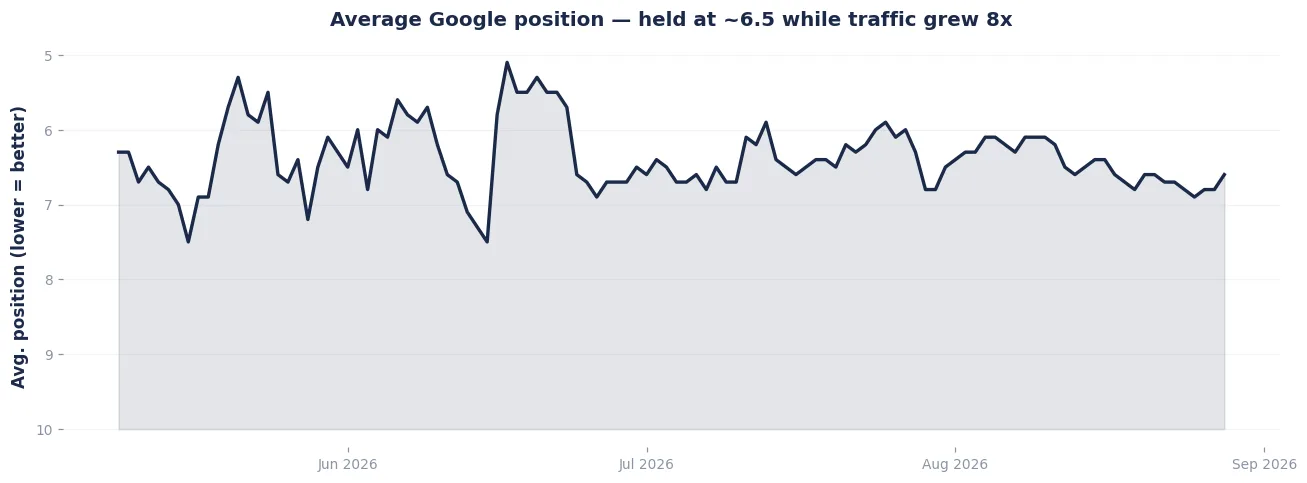
Every figure below is real Google Search Console data — 9 May to 28 August 2026.
First two weeks vs last two weeks. Orange is after.
Growth without slippage — every month bigger, rankings intact.
144/day
Position 6.4
Query expansion
begins
2,220/day best
Position 6.4
Scale held
Position 6.5
A mobile-first South Asian audience with deep product fit.
of clicks came from mobile — a phone-first audience
of clicks came from Pakistan — core market
of clicks from the flagship tool page — defended first
Questions People Ask About Scaling SEO
Why hide the niche? Doesn’t that make the case study less convincing?
The client asked for confidentiality, and we honor it — the metrics are what matter. Every number here is real Google Search Console data, and the strategy is described in full. An anonymized case study with verified numbers beats a named one with vague claims.
Isn’t 8x easier when you start on page one?
Starting on page one helps — but scaling from it is where most sites fail. The usual pattern is: add pages, dilute focus, watch average position slide, and end up with more pages and less traffic. Holding position while growing clicks 8x is the hard part, and it’s what this engagement was designed around.
One page driving 75% of traffic — isn’t that fragile?
It’s concentrated, not fragile — the page is the site’s core utility and its rankings are defended first in every change we make. And the concentration is decreasing over time: the supporting pages we built now contribute a growing share.
Why does mobile matter so much here?
98% of this site’s clicks come from phones. For utility websites, the tool is the product — if it loads slowly or handles poorly on mobile, users bounce and Google notices. Every technical decision in this engagement was made for the phone screen first.
What would an engagement like this cost?
Scaling engagements of this shape typically sit within our Growth plan range — see our SEO pricing for current figures. A free audit of your site’s current position and headroom gives the exact quote. Past results don’t guarantee future rankings — here’s how we talk about expectations.
More Case Studies
All Case Studies
Every SEO case study and client result, in one place.
Browse all case studies →635x Organic Clicks in 4 Months — Pakistani CSS Syllabus Website
Pakistani CSS syllabus website.
Read the case study →Zero to Page 1 in 90 Days — Karachi Construction Company
Construction company — Karachi.
Read the case study →257x Organic Clicks — Pakistani Exam-Prep Website
Pakistani exam-prep website.
Read the case study →+736% Organic Clicks in 90 Days — Dubai Mobile Car Service
Mobile car service — Dubai, UAE.
Read the case study →Want results like these for your business?
Every engagement starts with a free audit — see exactly what’s holding your site back before you spend a rupee.
Past results don’t guarantee future rankings — here’s how we talk about expectations.