Picture a supplier of industrial valves in Dammam. His website looks fine. He paid for “SEO” last year. Yet when a plant manager in Jubail searches what he sells, a weaker competitor shows up and he doesn’t.
Most ranking failures are one or more of the SEO mistakes to avoid below, and almost all are fixable. At EazyRankSEO, this list is our diagnostic for every engagement.
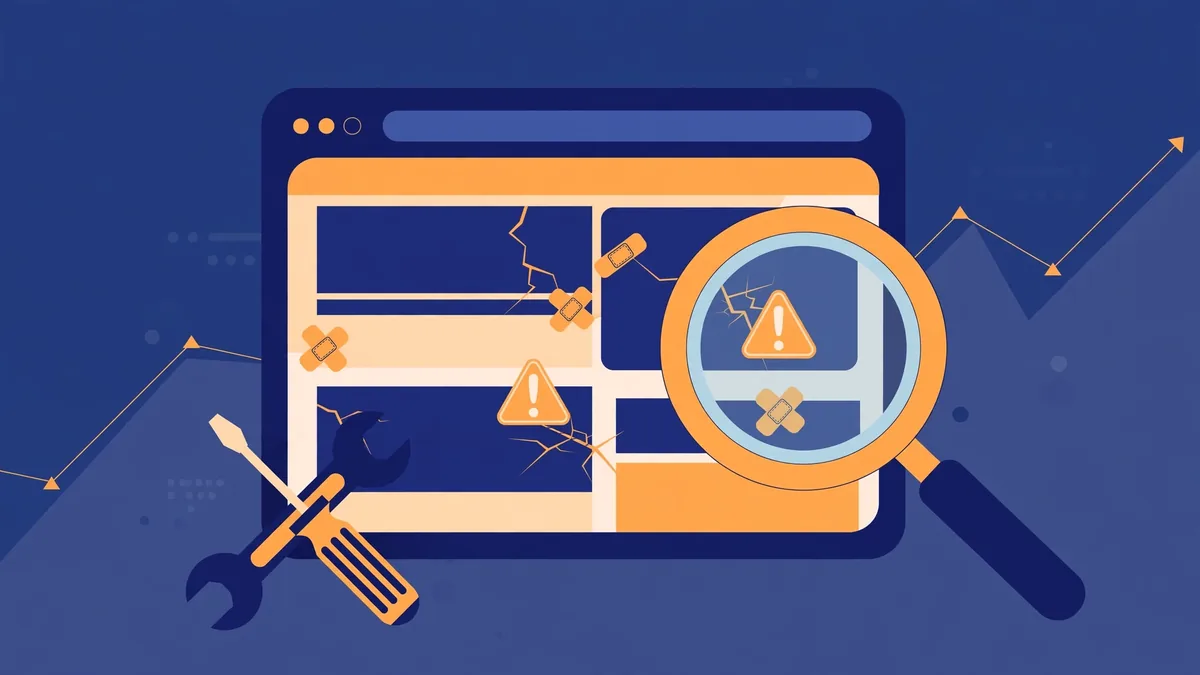
SEO mistakes to avoid are the recurring errors that suppress a website’s visibility in Google: targeting the wrong keywords, ignoring search intent, stuffing keywords, publishing thin content, neglecting technical foundations, weak internal linking, duplicate content, buying links, ignoring local SEO, and expecting overnight results. Each of the 15 below includes the mistake, why it kills rankings, and the fix — facts verified October 2026.
1. Are you targeting keywords your site cannot win?
Mistake #1 — skipping keyword research and chasing impossible keywords. A new Dammam supplier targeting “industrial valves” competes against manufacturers with thousands of backlinks and a decade of domain authority. Google will not rank you for it — the most expensive of all SEO mistakes to avoid, because every hour spent here is wasted.
The fix: run honest keyword research before writing a single page. Check the domain authority of the sites currently ranking: if they are 30+ points above you, pick a narrower fight — “butterfly valve supplier Dammam” instead of “industrial valves.” Long-tail keywords earn a higher click-through rate and conversion rate. This single habit prevents the most expensive SEO mistakes to avoid.
2. Does your content match what the searcher actually wants?
Mistake #2 — ignoring search intent. Google “best CRM software” and you get comparison pages. Publish a 3,000-word explainer where buyers wanted a comparison table, and visitors bounce in seconds. Google reads that bounce as irrelevance and your rankings sink. Intent mismatch is the silent killer of otherwise well-written content.
The fix: search the keyword in an incognito window and study the top 5 results. Match their format: comparison pages for “best X,” guides for “how to,” product pages for transactions. If the SERP shows a featured snippet, answer in under 50 words at the top. With AI Overviews and voice search growing in Saudi Arabia, intent-matching matters more than ever.
3. Are you stuffing keywords and publishing thin content?
Mistake #3 — keyword stuffing. Repeating “valves Dammam” forty times on one page doesn’t convince Google; it flags manipulation. Google’s spam policies penalize stuffing, and 2026 detection is faster than ever. Fix it with natural placement: keyword in the meta title, H1, and first paragraph — synonyms and related terms everywhere else (2026 roundup).
Mistake #4 — publishing thin, low-value content. Three-hundred-word product pages give Google nothing to rank.
The fix: every important page should fully answer its query — 500+ word product pages with specs and FAQs; 1,500+ word blog posts with genuine depth. Google’s E-E-A-T framework rewards first-hand expertise.
Mistake #5 — letting old content rot. A 2022 guide with outdated prices and dead links loses rankings — one of the SEO mistakes to avoid that businesses never notice, because the pages used to rank.
The fix: run a content audit every 6 months — update statistics, refresh examples, fix broken links. Refreshing a decaying page usually beats writing a new one: you keep its existing backlinks and authority.
4. Are your technical foundations solid?
Mistake #6 — never running a technical audit. Broken pages, crawl errors, and indexation problems accumulate silently. A site can have perfect content and still be invisible if Googlebot can’t crawl it. Fix it with a monthly Search Console routine: check the Page Indexing report, run Screaming Frog quarterly, and submit a clean XML sitemap.
The fix: validate your schema markup in Google’s Rich Results Test, then work through our seo audit checklist — all 25 checks. A detailed 2026 audit-process guide walks through each step.
Mistake #7 — a slow, mobile-hostile website. Most Saudi customers meet your business on a phone first — and with mobile-first indexing, Google judges your mobile version. Google’s Core Web Vitals (LCP under 2.5s, INP under 200ms, CLS under 0.1, October 2026) measure exactly that experience.
The fix: test your pages in PageSpeed Insights. Compress images, remove unused plugins, and consider better hosting — decent Saudi hosting runs SAR 50–200/month as of October 2026.
5. Is your site’s internal wiring broken?
Mistake #8 — weak internal linking and orphan pages. Pages with no internal links are nearly invisible: Google discovers content by following links. Money pages sit two clicks from nowhere, getting zero organic traffic. Fix it by linking every page from at least three relevant others, with descriptive anchor text that builds topic clusters.
The fix: link every page from at least 3 relevant others, with descriptive anchor text. Important pages deserve many more.
Mistake #9 — duplicate content and keyword cannibalization. Five near-identical service pages split your ranking power five ways.
The fix: consolidate overlapping pages into one definitive page with 301 redirects, and use canonical tags where duplicates must exist. Among SEO mistakes to avoid, cannibalization is the most self-inflicted.
6. Are you buying links or cutting corners on authority?
Mistake #10 — buying backlinks and spammy link schemes. Paying for 500 backlinks, joining link farms, or blasting guest posts with exact-match anchor text violates Google’s spam policies outright. The March and September 2026 spam updates sharpened detection of manufactured links. Shortcuts that “worked” in 2020 now trigger manual actions.
The fix: earn links the slow way — digital PR, original data, genuine guest posts, broken link building. Buying links remains the SEO mistake to avoid with the harshest penalties. One editorial link from a respected Saudi publication outweighs a thousand spammy ones — a 2026 breakdown of over-optimization mistakes confirms the pattern. If your profile has toxic links, read our guide to toxic backlinks before touching the disavow tool.
7. Are you invisible where Saudi customers actually search?
Mistake #11 — ignoring local SEO entirely. A Khobar clinic with no claimed Google Business Profile, no reviews, and inconsistent listings is invisible for “clinic near me” searches — the searches that drive foot traffic. For local businesses, the local pack matters more than organic rankings, and most Saudi SMEs haven’t even claimed their listing.
The fix: claim and complete your Google Business Profile, keep your name/address/phone identical everywhere (NAP consistency), and build genuine customer reviews and star ratings steadily.
Mistake #12 — inconsistent NAP data across the web. Your site says “King Fahd Road” but a directory says “K.F. Road.” Google reads conflicting addresses as untrustworthy and demotes your local visibility — a classic local SEO mistake to avoid.
Why Dammam and Khobar businesses lose local searches they should win
Eastern Province B2B runs on English-dominant queries — “valve supplier Dammam,” “industrial catering Khobar.” Yet most Dammam industrial sites have English-only GBP listings and zero reviews from procurement managers. The fix: bilingual profiles, geo-targeting across Dammam–Khobar–Jubail–Dhahran, and a B2B review process.
8. Are you expecting SEO to work like paid ads?
Mistake #13 — expecting instant results and quitting at month three. SEO typically takes 3–6 months to show movement and 6–12 months for steady leads. Businesses that pull the plug at week eight waste everything they spent — this expectation gap kills more programs than any algorithm update ever will.
The fix: track leading indicators (impressions, indexed pages, keyword movements) in Search Console and Google Analytics, not just revenue. Read how we talk about SEO results — ranges, not guarantees, is the only honest framing.
Mistake #14 — treating SEO as a one-time project. Algorithms update, competitors publish, content decays. A site “optimized” in 2024 and untouched since is already losing ground.
The fix: budget for ongoing work — monthly technical checks, quarterly content refreshes, continuous link earning.
Mistake #15 — hiring on price alone. The cheapest “SEO package” usually means automated reports and zero real work — and most businesses never defined what a lead is worth. It is one of the SEO mistakes to avoid that drains budgets quietly.
The fix: know what a qualified lead is worth, then judge providers on reporting transparency, Saudi-market experience, and realistic timelines. Our SEO services start with that math — and you can see our SEO pricing to compare plans.
Frequently Asked Questions
What are the most common SEO mistakes in 2026?
The most common SEO mistakes to avoid are targeting keywords your site can’t win, ignoring search intent, keyword stuffing, thin content, slow mobile performance, weak internal linking, duplicate content, buying backlinks, ignoring local SEO, and expecting instant results. Most ranking failures trace back to three or four of these compounding. Fix the technical ones first — they unlock everything else.
Can SEO mistakes cause a Google penalty?
Some can. Buying links, link schemes, scaled spammy content, and cloaking can trigger manual actions that remove your site from Google’s results — these are the dangerous SEO mistakes to avoid at all costs. Most mistakes cause quiet suppression instead: thin content, slow pages, and intent mismatch make you lose to competitors without notification. Check Search Console’s Manual Actions report.
How long does recovery take after fixing SEO mistakes?
Typically 4–12 weeks after major fixes, depending on the mistake and authority. Technical fixes (indexation, redirects) often show movement within weeks once Google recrawls. Content and link-profile recoveries take longer — Google needs to re-evaluate quality signals over time. Penalty recoveries can take several months and a reconsideration request. Track impressions in Search Console as your early signal; traffic follows.
Is keyword stuffing still penalized in 2026?
Yes. Google’s spam policies target keyword stuffing, and its 2026 systems detect unnatural repetition. Stuffing also destroys readability, which hurts the user-experience signals that influence rankings. The safe rule: use your keyword in the meta title, H1, first paragraph, and one or two H2s, then write naturally. If a sentence sounds awkward to a human reader, it will sound manipulative to Google too.
Why is my website not ranking on Google?
Work through the SEO mistakes to avoid in diagnostic order. First, check indexation in Search Console — unindexed pages can’t rank, and the cause is usually technical (robots.txt, noindex tags, crawl budget). Second, verify your keyword targeting is realistic. Third, check search intent against the top 5 results. Fourth, assess page speed. Most “invisible site” cases resolve at step one or two — they’re access problems, not quality problems.
كيف أتصدر نتائج البحث في جوجل بعد سنوات من أخطاء السيو؟ (kayfa atasaddar nata’ij al-bahth fi google — “how do I rank at the top of Google search results”, MSA)
ابدأ بالتشخيص قبل الإصلاح: افحص الفهرسة في Google Search Console، ثم راجع استهداف الكلمات المفتاحية ونية البحث. أصلح الأخطاء التقنية أولاً (الفهرسة، السرعة، الروابط المعطلة)، ثم عمّق المحتوى الرقيق، ثم ابنِ روابط خلفية نظيفة. التعافي يستغرق عادة من 4 إلى 12 أسبوعاً بعد الإصلاحات الكبرى. تجنب الاختصارات — شراء الروابط بعد عقوبة سابقة يفاقم المشكلة. الصبر والاستمرارية أهم من أي حيلة سريعة.
Do broken links hurt SEO?
Broken internal links waste crawl budget. The real damage comes at scale: hundreds of broken links signal a neglected site. Fix them at the source rather than mass-redirecting everything to the homepage (Google treats that as a soft 404). A quarterly broken-link check with Screaming Frog takes under an hour for most sites — small sites can finish it in an afternoon.
Should I fix SEO mistakes myself or hire an agency?
Fix the basics yourself: claim your Google Business Profile, fix title tags, compress images, ask customers for reviews, and publish genuinely useful content — these cover most of the 15 SEO mistakes to avoid and cost only time. Hire help for mysteries: sudden traffic drops, penalty recovery, technical issues beyond your comfort zone, or competitive markets needing sustained link earning.
How often should I audit my site for SEO mistakes?
Twice a year for a site; quarterly if you publish regularly or compete in a fast market. Always audit after a redesign, migration, domain change, or unexplained traffic drop. Between full audits, check Google Search Console monthly — index coverage, Core Web Vitals, and manual actions break silently. Catching the SEO mistakes to avoid early is always cheaper than recovering late.
Remember the Dammam supplier? His problem was five compounding issues: unrealistic keyword targeting, thin product pages, an unclaimed Google Business Profile, zero internal linking, and a site that loaded in six seconds on mobile. The lesson of these SEO mistakes to avoid: rankings rarely die from one wound.
Your three steps this week: Step 1 — confirm your money pages are indexed in Search Console. Step 2 — pick the three mistakes that match your site and fix them in order. Step 3 — if the problem survives, get professional eyes on it: our SEO services start with exactly this diagnostic, and our SEO pricing is deliberately set below typical Saudi agency rates.
About the author: Mohammad Muttiullah is the Founder of EazyRankSEO, an SEO agency serving businesses across Saudi Arabia. He leads technical SEO audits and strategy for Saudi SMEs. Learn more about our team.